
Commercial electric rate analysis: choosing the right tariff and preparing for a rate change
Most commercial buildings qualify for more than one electric rate, and utilities keep changing them. Here is how to see what a rate change will cost you before it reaches your bill.
Utilities are changing how they charge commercial and industrial customers. As states and cities cut carbon from their power supply and add solar, wind and storage to the grid, utilities use rate structures to move demand to the hours when clean power is plentiful. The most visible result is the move to time-of-use (TOU) rates, which charge more for electricity used in the late afternoon and evening, and less at other times.
For a business, that creates two questions. Which of the rates you qualify for costs least for the way your building actually uses power? And when the utility moves you to a new rate, how much will your bill change? Both are answered the same way: by recomputing your bills under each rate, from your own meter data.
What you pay for on a commercial electric bill
A commercial electric bill usually combines several charges, and each one reacts differently to a rate change:
- Energy charges, per kilowatt-hour (kWh). On a time-of-use rate the price depends on the hour, the day of the week and the season.
- Demand charges, per kilowatt (kW), set by the highest 15-minute average power the building drew in the billing period, sometimes only within peak hours. A single bad afternoon can set this charge for the whole month.
- Fixed charges, such as a monthly customer or meter charge.
- Other items, such as taxes and fees and, if you buy power from a Community Choice Aggregator (CCA) or an electric service provider, separate generation charges and exit fees.
Because these pieces move in different directions, two buildings on the same new rate can see very different results. A building with a steady load and a low peak may save money. A building that runs hard in the late afternoon may pay noticeably more.
What a mandatory rate change can cost
When PG&E prepared to move business customers onto new time-of-use rates in 2021, we modeled the change for the buildings on our platform. The estimated increases in annual electric costs depended on the type of building:
| Building type | Estimated change in annual electric costs |
|---|---|
| Libraries | +8% to +10% |
| Restaurants | +9% to +13% |
| Hospitals | +6% to +9% |
| Offices | +6% to +9% |
| Other commercial buildings | +6% to +13% |
These are averages from our 2020 analysis of that transition, not a forecast for your building. The spread within each building type is the point: the same rate change costs some buildings far more than others, depending on when they use power.
Example: four public libraries
For a group of four libraries, we recomputed every 2019 bill under the new time-of-use rate, using each library's 15-minute meter data, and compared the result with what the libraries had actually paid.
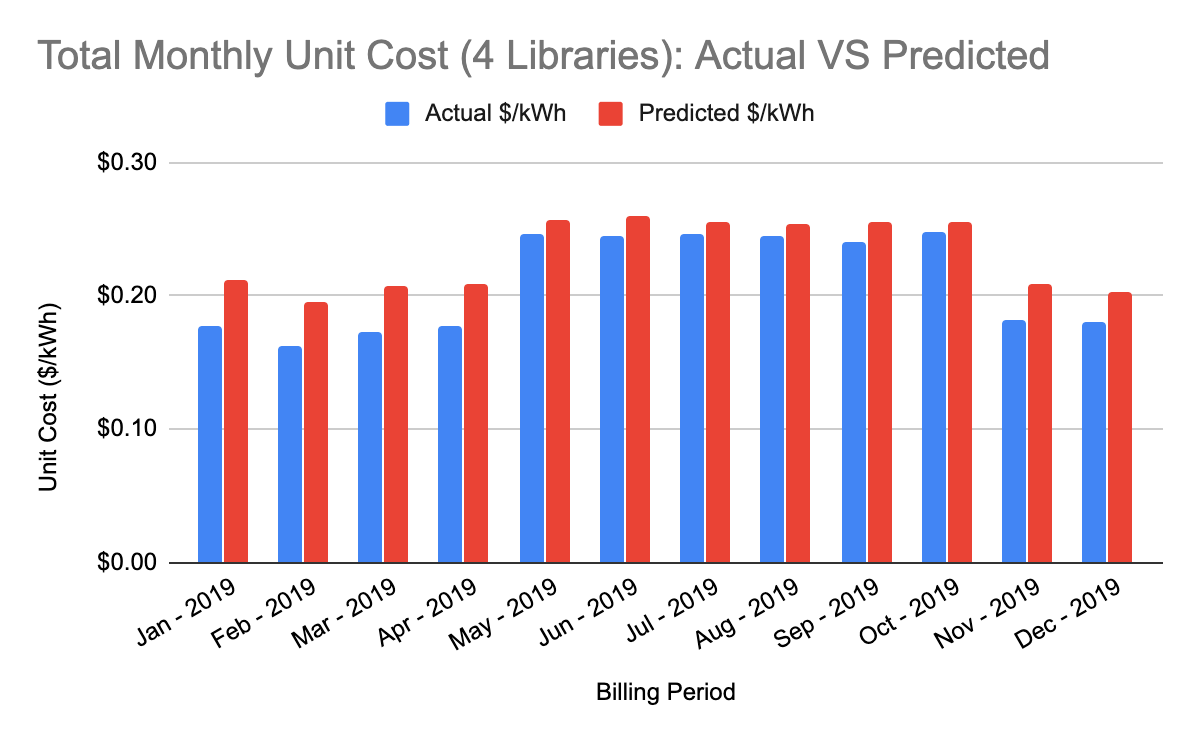
The new rate would have cost more in every month, but not evenly. In the winter months the gap was about 3 cents per kWh. In summer, when the old rate was already expensive, it was about 1 cent. That pattern tells the libraries where to look: the extra cost comes from winter usage in the hours the new rate prices highest, so moving or trimming load in those hours is where the savings are.
How a rate analysis works
- Collect the data. Twelve months or more of utility bills and 15-minute interval data from the building's smart meter. With your authorization this can be pulled directly from the utility, with no new hardware.
- Break down the current bill. Split each bill into energy, demand, fixed and other charges, so you know which part of the bill a change would affect.
- Find the eligible rates. List every rate the account qualifies for, and any mandatory rate change the utility has announced.
- Analyze the load profile. Look at when the building uses power: daily and seasonal shape, peaks, and how much load falls in the most expensive hours.
- Simulate the bills. Recompute every month under each candidate rate from the interval data, and check the model by reproducing the bills you actually paid on your current rate.
- Compare the impact. Show the change in cost for each rate, by month and by charge type, as a percentage and in dollars.
- Plan operations around the rate. Identify what you can change, such as shifting schedules, pre-cooling, staggering equipment start-ups or adding storage, to cut costs on the rate you choose.
The step most often skipped is the check in step 5. A simulation that cannot reproduce your past bills to within a small margin will not predict your future ones either.
A checklist before your next rate decision
- Get at least twelve months of bills and 15-minute interval data for each account, so every season is covered.
- Ask your utility account representative which rates each account is eligible for, and whether a mandatory change is scheduled.
- Model each eligible rate on your own data instead of relying on averages for your building type.
- Check the rules for switching. Utilities usually limit how often an account can change rates, so a wrong choice can last a year.
- Repeat the analysis when operations change, when you add solar, batteries or EV charging, and whenever the utility revises its rates.
Questions we hear about rate changes
How often should a business review its electric rate?
At least once a year, and whenever something changes: the utility revises its rates or announces a mandatory transition, the building's operating hours change, or you add solar, battery storage or EV charging.
Do we need to install new meters for a rate analysis?
Usually not. Most commercial buildings already have smart meters that record usage every 15 minutes, and with your authorization that data can be retrieved from the utility together with your bills.
Can a time-of-use rate lower our bill?
It can, if the building uses less of its power in the expensive late-afternoon and evening hours, or can move load out of them. Whether it does for your building depends on your load profile, which is why the rates should be compared on your own interval data.